
The Burden of Unemployment in Nigeria
 admin
adminThe Burden of Unemployment in Nigeria
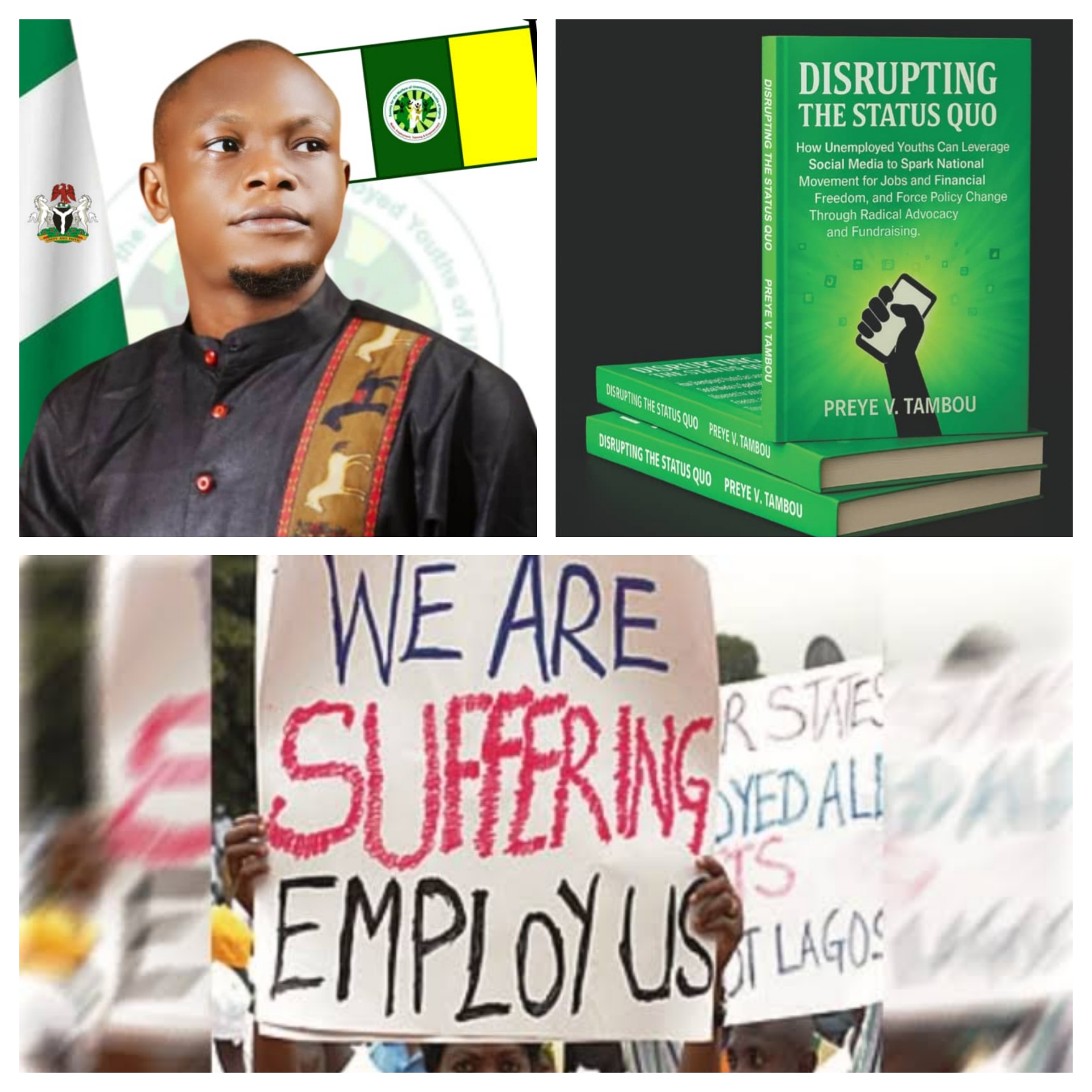
By Comr. Preye V. Tambou, National President, Society for the Welfare of Unemployed Youths of Nigeria (SWUYN)
4th December, 2025
“A society that does not find work for its youth will find trouble with them instead.”
~ Amílcar Cabral
A nation is not measured by the towers in its cities or the barrels beneath its soil, but the dignity it affords its young. By this standard, Nigeria stands in peril. Independence promised not only freedom from colonial rule but opportunity for every citizen. That covenant has been broken.
The burden of unemployment in Nigeria is a heavy weight carried not only by individuals, but families, communities, and the nation’s economic future. It stretches across urban cities and rural settlements, trapping millions of young people in cycles of frustration, dependency, and unrealized potential. Despite Nigeria’s abundant human and natural resources, the widening gap between employable youths and available opportunities has created a crisis that threatens social stability, national productivity, and long-term development.
Unemployment has become Nigeria’s silent epidemic, more corrosive than inflation, more destabilizing than insecurity. It fuels poverty, insecurity, and brain drain, pushing talented Nigerians to seek survival rather than growth. It is a slow violence, robbing individuals of purpose, families of stability, and the nation of progress. Families lose breadwinners, young graduates lose hope, and communities lose the vibrancy necessary for innovation and progress. Every year, thousands enter the labour market with skills the economy is not ready to absorb, while many others remain underemployed, earning far below their potential. Unlike famine, which starves the body, or war, which destroys the land, unemployment erodes the soul. It kills without blood.
The Faces Behind the Figures
Statistics tell us that more than half of Nigerian youths are either unemployed or underemployed but numbers cannot capture the boy in Kano who spends his mornings at the roundabout, hoping for casual labour that never comes. They cannot show the girl in Port Harcourt, diploma in hand, who hawks food on the roadside to pay her siblings’ school fees, they don’t show the sexhawkers on the streets exchanging their most important value for coins. They do not reveal the shame of the graduate keke or ogada driver, who lowers his head each time he ferries a former classmate.
Youth Unemployment in Nigeria
2020: 53.4%
2023: 49.9%
2024: 36.2%
Global Average: 13%
These are not isolated struggles; they are the untold stories of millions.
Despite a slight decline, Nigeria’s 2024 unemployment rate of 36.2% is still deeply troubling. It remains nearly three times the global average, reflecting an economy struggling to create opportunities for its young population. This level of unemployment is not just a statistic but a loud warning about the widening gap between potential and reality, and the urgent need for intentional, transformative policies to secure a future that Nigerian youth can trust.
How Unemployment Pushed Nigerians Into an Overcrowded PoS Survival Economy
Many Nigerians, including degree holders, have been pushed into PoS work just to survive. Graduates like Tunde, after hundreds of failed job applications, now sit under umbrellas competing with several operators on the same street. Engineering graduates like Amarachi share crowded junctions with more than a dozen PoS stands, waking early just to secure a space. Former teachers like Zainab abandoned N35,000 salaries for daily PoS income that has now dropped because new operators flood every corner. Even NYSC members like Ibrahim save their allowance to start PoS only to meet stiff competition within months. Mothers like Mrs. Bola, who lost their jobs, rely on PoS to feed their children despite earning almost nothing as more operators appear beside them. Across Nigeria, unemployment has turned PoS business into a survival refuge for thousands, overcrowded and barely profitable, yet still the only option many have left.
The Graduate Hawker
At the busy Ojota bus terminal in Lagos, commuters weave between honking danfos and shouting vendors. In the middle of the chaos, a young man in a neatly ironed shirt balances a tray of bottled water on his head. His name is Osarugue.
Osarugue is 27 years old. He graduated from the University of Benin with a degree in Economics. His project thesis, a 120-page study on microcredit, earned him a first-class. His parents slaughtered a goat to celebrate. His future seemed bright.
That was four years ago. Since then, Osarugue has applied for over 80 jobs. Banks never called back. Ministries demanded “connections.” Multinationals asked for five years of experience he could not have. Each rejection letter chipped away at his confidence, until even rejection stopped coming.
Now he hawks water in traffic. He earns about N2,500 on a good day, less than the cost of the textbooks he once bought yet, when asked, Osarugue does not say “I am a hawker.” He still says: “My name is Osarugue. I studied Economics.” His degree clings to him like a last piece of dignity, even as hunger strips him bare.
According to graduate labour surveys, over 600,000 graduates join Nigeria’s labour market every year, but only about 10% find formal jobs. The rest scatter into survival: hawking, okada riding, cybercrime, or idleness. Every bottle Osarugue sells is more than water but wasted potential, an economist reduced to traffic.
“I don’t mind hard work,” he says softly, adjusting his tray. “But I studied so I could build, not so I could beg.”
How many more Osarugue must Nigeria waste before disruption becomes inevitable?
The Psychological Price
Work is more than wages. It is rhythm, identity, and dignity. When denied work, young people are denied worth. Marriages are postponed, independence delayed, adulthood suspended. Depression rises, frustration mutates into anger, and an entire generation floats in economic adolescence.
When Joblessness Becomes Revolt
History warns what happens when unemployment festers:
Tunisia, 2010: Mohamed Bouazizi, a jobless vendor harassed by police, set himself ablaze. His act ignited the Arab Spring, toppling regimes across the region.
Europe, 1930s: The Great Depression left idle youths ripe for fascism, fueling Hitler and Mussolini’s rise.
Latin America, 1980s: Economic collapse and joblessness birthed revolts that reshaped nations.
Nigeria, 2020: #EndSARS, sparked by police brutality, carried within it the fury of millions denied opportunity.
If the young are denied the table, they will overturn it.
Nigeria’s Cruel Paradox
Nigeria is a nation of contradictions. Rich in oil, poor in opportunity. Africa’s largest youth population, yet among the highest jobless rates. Universities churn out graduates, industries lie in ruins. Two Nigerias exist:
One small, wealthy, and shielded.
Another vast, restless, and denied.
The survival of the first depends on the patience of the second but patience, like oil, is finite.
Fuel for Insecurity
Idle hands are never neutral. Boko Haram’s earliest recruits were not zealots but jobless young men searching for purpose. Today’s kidnappers and bandits are often unemployed youths who found guns more profitable than waiting for jobs. Cybercrime thrives because graduates, brilliant but abandoned, turn their skills toward fraud.
In Benin City, Ogosa, a 27-year-old Computer Science graduate, runs a cybercafé. To outsiders, it looks like a small business but behind the curtains, it is a hub for online fraud. “If I code for companies, they pay me late or not at all. If I scam, I get paid in hours.” His words sting, not because they justify crime, but because they expose a nation’s betrayal.
Cosmetic Cures, Collapsing Trust
Governments have tried but on paper. Operation Feed the Nation. N-Power. YouWin, SURE-P, S2W, LEEP, iSTEP, N-SIP, NiYA, NYIF, YEIDEP and more others. Each announced with pomp, underfunded, and forgotten. Billions vanish, impact remains invisible. Today, when new “youth empowerment schemes” are announced, the response is not hope but laughter.
The Digital Megaphone
This generation is different. Social media has ended silence. Twitter threads, TikTok videos, WhatsApp groups, Facebook rants – these are the new town halls. They turn frustration into fire, local pain into global visibility.
#EndSARS proved it. A decentralized, leaderless movement raised funds online, organized logistics digitally, and captured the world’s attention. For the first time, the unemployed realized their pain was not personal but collective, and collective pain is power.
The Generational Theft
Unemployment is not just about hunger today but poverty tomorrow. A graduate who spends a decade idle cannot recover lost time. Energy wasted, innovation delayed, and years stolen. This is not only personal tragedy but national suicide. Nigeria is not merely wasting oil. It is wasting generations.
At the Crossroads
Nigeria now stands before two roads.
One is denial: endless statistics, recycled slogans, policies that impress donors but ignore citizens. That road leads to collapse. A State that abandons its youth will one day be forced to fight them.
The other is disruption: a generation that refuses silence, that organizes and demands transformation. Independence was seized, not gifted. Democracy was demanded, not offered. The struggle for jobs and dignity will be no different.
Remember, this is not written to depress but to awaken. The burden of unemployment is heavy, but it also carries the spark of transformation. Every revolution in history was born of a generation that refused exclusion. Nigerian youths today stand in that lineage.
History does not remember the silent sufferers. It remembers the loud disruptors and when a nation’s youth are locked out of its future, disruption is not rebellion. It is survival.

