
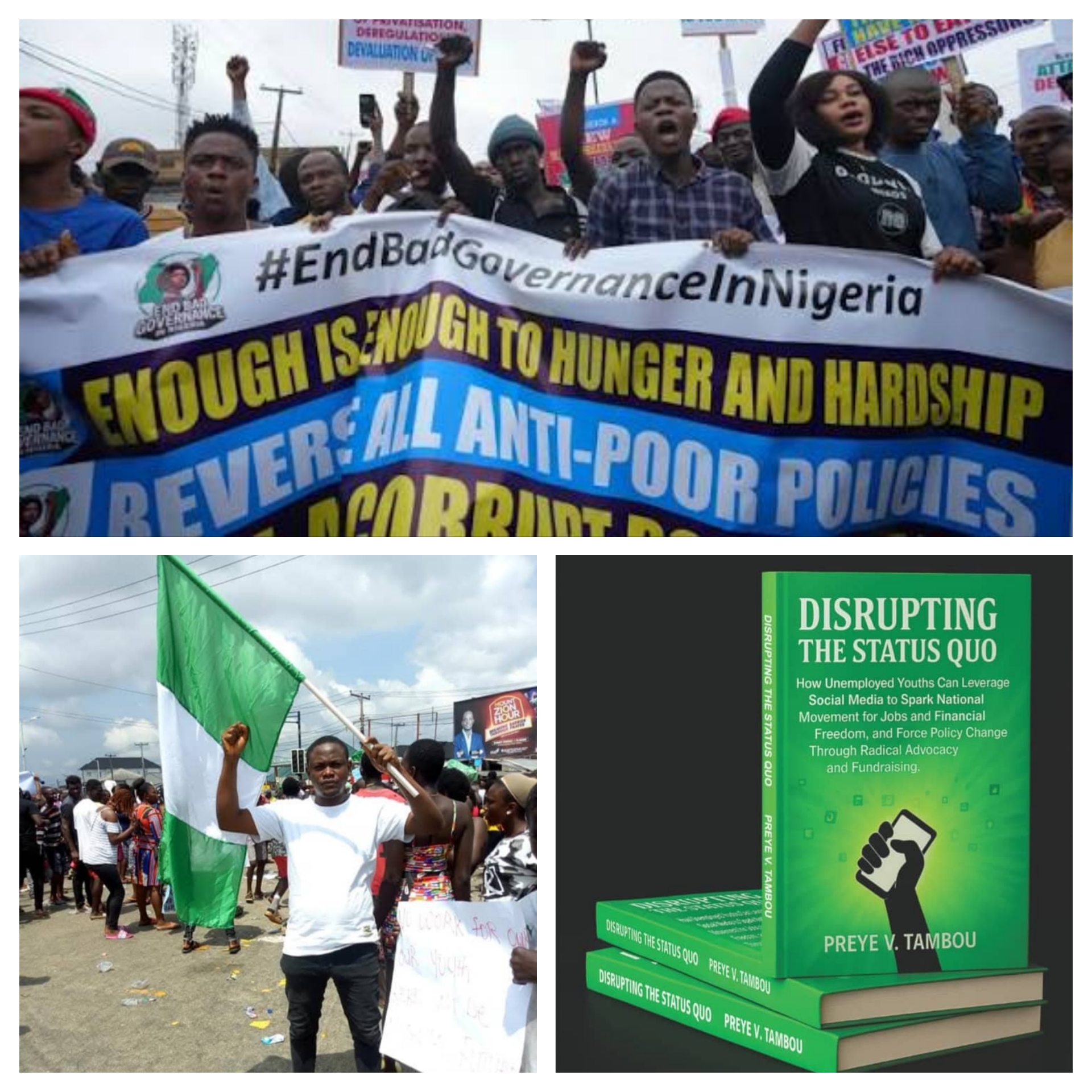
Youth as the Vanguard of Change – From Anger to Agenda
 admin
adminYouth as the Vanguard of Change – From Anger to Agenda
By Comr. Preye V. Tambou, National President, Society for the Welfare of Unemployed Youths of Nigeria (SWUYN)
12th December, 2025
“They tried to bury us. They didn’t know we were seeds.” ~ Preye V. Tambou
Nigeria is a nation where youth are not just a demographic – they are destiny. Over 70% of the population is under 35. In raw numbers, that means more than 140 million Nigerians are young yet this restless majority is ruled by a fragile minority of old men in agbadas and uniforms who have proven overtime that they lack courage, integrity, and independent conviction – lawmakers, stakeholders, and leaders who trade their voice for political convenience.
This imbalance is not sustainable. The youth are not the future, they are the present, flesh and pulse of the nation today but without organization, they remain an angry crowd, not a political force.
Anger makes noise. Agenda makes history.
The Power of Anger
Anger is not weakness but fuel. Every Deji hawking sachet water in Lagos traffic, every Zainab searching for a job after graduation, every Chuks trapped in cybercrime because there are no alternatives – all carry legitimate anger.
Anger mobilizes. Anger fills the streets. Anger makes hashtags trend. Anger pulls down walls but anger without agenda burns fast and fades faster. #EndSARS showed the power of youthful anger, but also its weakness: without structure, the State outlasted the storm.
History proves it:
Tunisia’s youth anger toppled a dictator, but only structured political groups shaped what followed.
South Africa’s Soweto generation fueled resistance, but it took ANC organization to end apartheid.
Nepal’s Gen Z protests forced resignation, but without a clear agenda, reforms remain fragile.
Anger starts revolutions. Agenda sustains them.
From Crowd to Movement
A crowd is spontaneous. A movement is strategic. The Nigerian youth must learn to transform their numbers into coordinated force.
How?
1. Organization Beyond Protest.
Youth unions, digital platforms, and grassroots collectives must evolve into lasting institutions. No uprising succeeds without structure.
2. Leadership Without Godfathers.
The youth must reject recycled leaders sponsored by old cabals. Leadership should emerge from credibility, competence, and community trust, not from political patrons.
3. Clear Demands.
Anger shouts “Enough!” but agenda says “Here is what must replace it.” The youth must outline what they want: jobs, education reform, anti-corruption mechanisms, digital freedom, healthcare, security and good governance.
4. Strategic Patience.
Change is not instant. The old guard counts on youth fatigue but a movement that prepares for 5, 10, 20 years will outlast them.
Vignette: The Market Woman’s Son
Chidera, the son of a market woman in Aba, graduates with a degree in engineering. No job. He sells phone accessories at Ariaria market to survive. He joins protests online, tweets furiously, but nothing changes.
One day, instead of ranting, he joins a cooperative of 200 other jobless graduates. They pool resources to start a solar energy company. They not only employ themselves but power 500 homes. Their cooperative grows into a political voice demanding policies for renewable energy.
Chidera realizes something: resistance is not only protest but creation. By building alternatives, the youth weaken the grip of the corrupt.
The Tools of a Youth Vanguard
1. Digital Platforms.
Not just for hashtags, but for petitions, e-learning, crowdfunding, and policy tracking.
2. Grassroots Power.
Youths in rural areas must not be left behind. Mobilization must go beyond Lagos and Abuja to villages and towns where manipulation thrives.
3. Coalitions.
No single group can win alone. Students, artisans, techies, artists, farmers – unity is strength.
4. Narrative Control.
Youth must shape their own story. Stop waiting for politicians to define them as “lazy” or “unruly.” Own the narrative: We are builders, innovators, reformers, and leaders.
The Fear of the Elders
The ruling class mocks the youth as unserious. They say: “Youth cannot lead. They are distracted. They are inexperienced” but beneath that mockery lies fear.
They fear the energy of youth, which never tires.
They fear the numbers of youth, which overwhelm.
They fear the technology of youth, which they do not understand.
They fear the imagination of youth, which creates futures beyond their reach.
What they call inexperience is actually freshness. What they call recklessness is boldness. What they call laziness is untapped genius blocked by a system designed to frustrate.
From Street to Statehouse
The ultimate proof of youth power is not protest, but policy. Not burning parliament, but entering parliament. Not just fighting rulers, but becoming rulers.
This does not mean every young person must run for office but every young person must support credible youth leadership, whether in politics, unions, entrepreneurship, or civil society.
The Soweto generation eventually gave birth to leaders in post-apartheid South Africa.
Ghana’s independence was fought by young Kwame Nkrumah and his comrades.
Burkina Faso saw a 33-year-old Thomas Sankara reshape a nation in four years.
If others did it, Nigerian youth can too.
From street chants to senate seats- that is the journey of true change.
The Discipline of Hope
The hardest task for the youth vanguard is not anger but hope. In a nation where betrayal is routine and progress feels impossible, and cynicism is seductive, hope is a weapon. Without hope, there is no fight. Without hope, the crowd disperses. Without hope, chains remain unbroken.
Hope must be disciplined not naïve, shallow, but stubborn. Hope that organizes, strategizes, and refuses to die.
Nigeria does not need permission from old men to change. The youth must stop waiting to be invited to the table. Build your own table. Occupy your own table. Flip their table if necessary.
This generation must declare: We are not the leaders of tomorrow. We are the leaders of today.
History will not wait. The clock is ticking. Hunger is growing. Injustice is swelling. The volcano beneath Nigeria is heating.
If the youth do not seize their destiny, the destiny of Nigeria will be seized by decay.
The youth are not a problem to be solved. They are the solution waiting to be unleashed.
From anger to agenda. From protests to policies. From hashtags to highways. From the restless majority to the ruling majority.
This is the destiny of Nigeria’s youth: to rise as the vanguard of change. Not because the elders will hand them power, but because history demands it, and the future depends on it.
The youth are not the leaders of tomorrow – they are the earthquake of today.

